

D e c 15 · W r i t t e n B y B e t t e r U P l a n s
How to Stop Self-Sabotaging and Finally Get Out of Your Own Way
Self-sabotage · Overcoming-self-doubt · Personal-growth-for-women · ⏱ 9 Min read

This post may contain affiliate links. If you choose to grab something I recommend, I’ll earn a small commission (at no extra cost to you). Thank you for helping me keep creating resources that empower women like you!
Girl, have you ever caught yourself doing the thing again?
Putting off the important goal. Shrinking your own win down to "it was nothing."
Talking yourself out of the opportunity before anyone even had the chance to say no to you.
Congratulations, you've just met self-sabotage.
Sneaky, convincing, and running the show longer than you realize. Rarely does she come right out and announce herself; more often, you'll catch her wearing a sensible outfit and carrying a very convincing list of reasons to wait.
Here's what I want you to know before we go any further: this isn't about willpower, and it's not that you're lazy or "just not built for this."
At some point, this pattern may have helped you avoid criticism, rejection, disappointment, or the risk of being seen trying.
It made sense then, even if it's costing you now.
Self-sabotage is a learned pattern, wired in by fear and old beliefs, which means it can be unlearned, one conscious, uncomfortable, worth-it choice at a time.
Breaking it doesn't mean fear stops showing up. It means fear no longer makes every decision for you.
What You'll Learn
The real psychological root of self-sabotage (it's not what you think, and it's not a character flaw)
The seven most common ways women quietly block their own success
Real-life scenarios so you can spot the pattern in your own life
How faith becomes a practical tool for taking the next step before you feel ready
A gentler, more honest way to actually break the cycle
- 01 Why We Block Our Own Success
- 02 Procrastination Wearing a Perfectionist's Mask
- 03 The Inner Critic Running the Show
- 04 People-Pleasing Yourself Right Out of Your Own Dreams
- 05 Fear of Success (Yes, That's Real)
- 06 The Quiet Self-Destructive Habits
- 07 Starting Strong, Finishing Never
- 08 Overthinking Until You're Stuck — and How to Break the Cycle
Why We Block Our Own Success
Psychologists have a name for what happens in your brain during self-sabotage: it's a protection response.
Somewhere along the way, your nervous system learned that visibility or "too much" wasn't safe.
Maybe you were teased for being the smart one, or you watched someone get punished for outshining others.
Maybe staying small just kept the peace.
Your brain built a system to keep you there, not because it hates you, but because it's trying, in its clumsy overprotective way, to keep you safe from disappointment.
The tragedy is that this same system now stands between you and the life you actually want.
You can appreciate what the pattern was trying to do without continuing to let it choose your future.
The goal isn't to fight yourself harder. It's to help the part of you that expects danger realize that this moment may be different.
For me, this is where faith becomes practical. Trusting God reminds me that I don't need complete control before I take the next faithful step.
For you, that grounding may also come through prayer, scripture, quiet reflection, or a deep commitment to the values you want your life to reflect.
Let's walk through the seven ways this shows up, because once you can name it, you can catch it in real time
Procrastination Wearing a Perfectionist's Mask
You tell yourself, "I just want to get it right." Meanwhile, the deadline creeps closer and the "right moment" to start never actually arrives.
Here's the truth about perfectionist procrastination: it was never about quality, it's about safety.
If you never finish the thing, you never have to face the possibility that it wasn't good enough.
Waiting keeps the dream safe from criticism, but it also keeps you from discovering what could happen once it leaves your head.
Picture this: you've had the idea for your own business, book, or Etsy shop for over a year.
You've researched, made three logo mock-ups, read every "how to start" blog post out there.
What you haven't done is launch. That's not a discipline problem. That's fear wearing a very convincing perfectionist costume.
"Perfectionism is a twenty-ton shield that we lug around thinking it will protect us when, in fact, it's the thing that's really preventing us from taking flight."
— Brené Brown, The Gifts of Imperfection
You're not lazy, sis. You're carrying twenty tons of "what if it's not good enough" and calling it high standards.
The move isn't instant confidence, it's lowering the stakes. Set a timer for fifteen minutes and do the ugly first draft, on purpose.
The first fifteen minutes may feel awkward, exposed, or unimpressive. That doesn't mean you're doing it wrong. It may simply mean you've finally moved beyond preparation and into participation.
A timer and a blank page are enough to begin. When you need more structure, the GGG Planner can help break the larger goal into steps small enough that starting no longer feels like standing at the bottom of a mountain.
The Inner Critic Running the Show
You wouldn't let a stranger speak to you the way you speak to yourself. If you'd never say "you're not smart enough" to your best friend, ask why that voice gets a permanent seat at your table.
This inner critic usually didn't start as your voice. It's often a parent's disappointment or an ex's offhand comment, replayed until it sounds like your own thoughts.
Over time, you stopped hearing it as an old recording and started believing it was the truth about who you are.
Familiar doesn't mean factual. A thought can sound like you and still belong to an old wound.
Criticism can feel like preparation; if you find every flaw first, maybe no one else can surprise you with one. That's part of why the critic stays on duty.
Here's a scenario that might feel familiar: you finally share your work, an idea, a post, a business you started, and instead of feeling proud, your brain hunts for the flaw.
A typo. One person who didn't respond right away. An imperfect detail becomes "proof" you shouldn't have bothered.
That's not humility. That's the inner critic protecting itself.
You don't have to jump from cruelty to confidence. Try moving from cruel to fair. "I ruined everything" becomes "there's one part I want to improve."
Ask yourself, "Would I say this to someone I love?" If the answer is no, you're allowed to stop saying it to yourself too.
In prayer, you might ask God to help you see yourself with more truth than fear currently allows.
People-Pleasing Yourself Right Out of Your Own Dreams
You say yes to everything except the thing that actually matters to you.
The committee. The favor. The last-minute request. Meanwhile, your own goal sits on a sticky note, untouched for the third week in a row.
Somehow, everyone else's emergency keeps finding a reserved seat on your calendar while your own dream remains on the waitlist.
This one is sneaky because it looks like generosity, like being a good friend or a good mom.
The hard part is that people may have praised you for this pattern. Being dependable, helpful, and endlessly available can earn approval while quietly costing you your own life.
Think about the woman who spends her Saturday running errands for family, helping a friend move, saying yes to extra work, then collapses too exhausted to touch the online course she paid for six months ago.
She's not lazy. She's using other people's needs as a legitimate-sounding excuse to avoid her own.
Making room for your own work doesn't mean you care less about everyone else. It means you're finally including yourself among the people whose needs matter.
Start by protecting one appointment with yourself this week. Put it on the calendar before the empty space gets volunteered on your behalf.
The GGG Planner exists so your goals have a home on the calendar instead of getting quietly bumped every week by everyone else's priorities.
Fear of Success (Yes, That's Real)
This is the one nobody warns you about. We talk endlessly about fear of failure, but fear of success is just as real, and just as sneaky.
Success brings change, visibility, higher expectations, and sometimes distance from people comfortable with the old, smaller version of you.
Sometimes success genuinely changes relationships, responsibilities, schedules, and expectations.
You're not irrational for noticing that. The question is whether you're evaluating the change honestly, or letting fear decide before you gather the facts.
A real-life version: a woman gets offered the promotion she's wanted for two years, feels dread instead of excitement, finds reasons the timing is wrong, and turns it down, calling it the "practical" choice.
Sometimes it is. Sometimes it's self-sabotage in a very reasonable-sounding outfit.
The antidote isn't forcing false confidence. It's tolerating growth in small doses, letting yourself feel proud for thirty seconds before your brain rushes to minimize it.
Let the good news sit beside you before you immediately explain it away. You're allowed to grow slowly enough that your nervous system can come with you.
The Quiet Self-Destructive Habits
Staying up too late when your body is begging for rest. Skipping the workout again, even though you keep saying health is a priority. Staying in the situationship, friendship, or job that drains you, even when you know better.
These habits rarely look dramatic from the outside, which is what makes them so effective.
Underneath, these small daily choices quietly tell your nervous system that your well-being isn't a priority, reinforcing the very belief fueling the sabotage.
It may not be that she doesn't know what she needs. She may be exhausted, disconnected from herself, or so accustomed to placing her well-being last that care now feels optional.
Start with care, not punishment. The goal isn't to scare yourself into better habits. It's to make one choice that tells your body, "I am listening." Your body shouldn't have to submit a formal complaint before it gets water and eight hours of sleep.
Reflection can help you notice the belief underneath the habit, especially when you keep choosing against what you say matters.
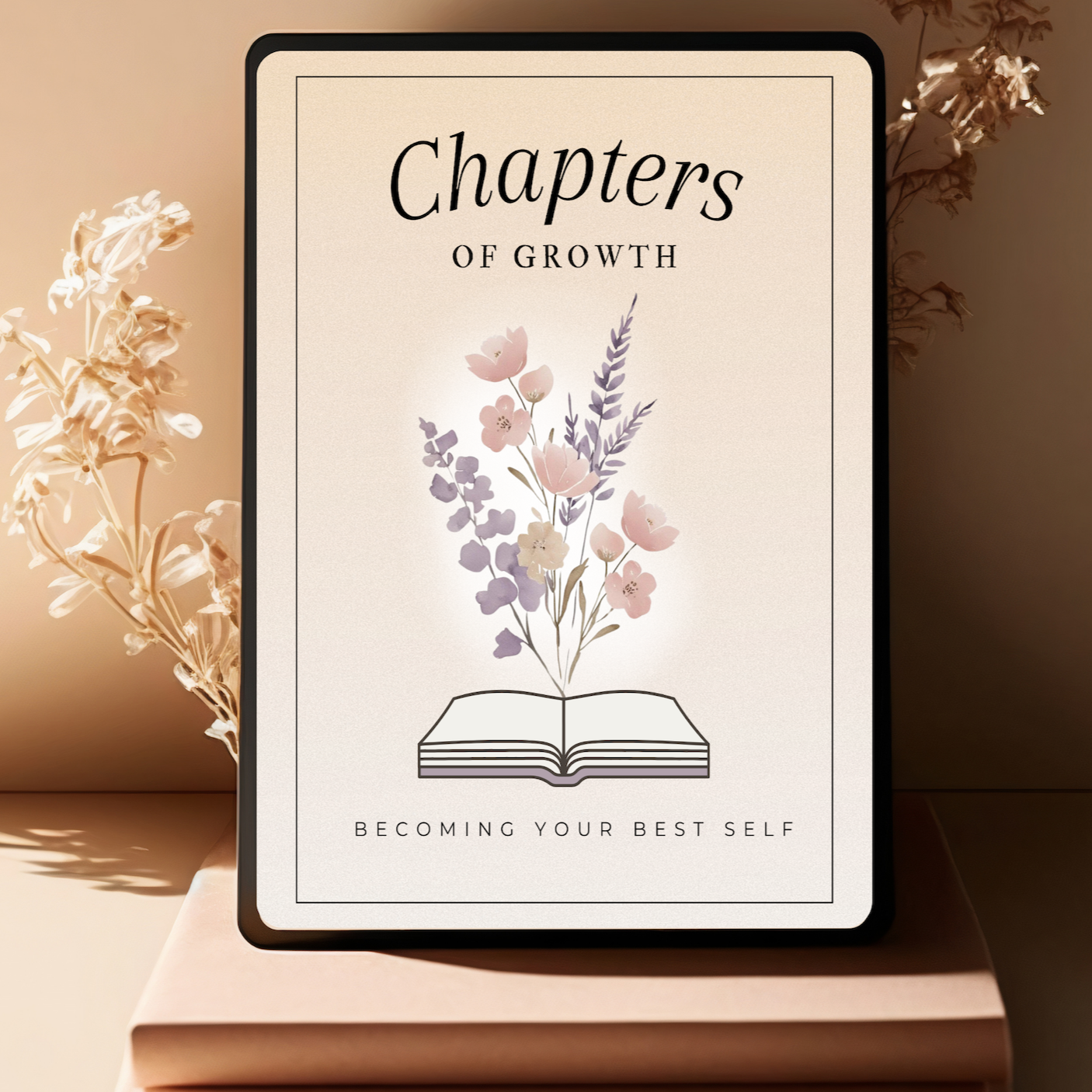
The Chapters of Growth Reading Journal gives those patterns and lessons somewhere to be examined, instead of repeated automatically.
Starting Strong, Finishing Never
You start with real excitement. New planner, new energy, "this time is different." Then, around week two or three, the motivation evaporates and you quietly let it go, telling yourself you'll "pick it back up later."
Self-sabotage loves an unfinished masterpiece, because an unfinished thing can never be judged as a failure.
As long as the manuscript is in a drawer, you never have to face the outcome.
Here's the honest scenario: a woman signs up for a twelve-week fitness challenge, crushes the first ten days, misses one workout, and that spirals into a missed week, then quietly deleting the app.
Missing one day is an event. Turning it into a verdict about who you are is the sabotage.
The real skill isn't perfect consistency. It's learning how to restart without creating a dramatic new beginning every time.
You don't need a new planner, a Monday, and a ceremonial playlist every time life interrupts the plan.
A visible record of what you did and what helped you return gives your mind evidence that one imperfect week doesn't erase your progress.
That's the purpose behind pairing your goals with your growth.
When you use the GGG Planner and the Chapters of Growth Reading Journal together as the Becoming System, your actions and reflection reinforce each other, making it easier to notice the pattern early and return before one missed step becomes a full disappearance.
Overthinking Until You're Stuck and How to Actually Break the Cycle
You analyze the decision from every angle. Still need more information. You need the right sign, for the timing to feel perfect.
Meanwhile, months pass, and you're exactly where you started, just more anxious about it.
Overthinking feels productive, responsible, thorough. You may be trying to find the one decision that guarantees you'll never feel embarrassed, disappointed, or uncertain afterward.
That decision usually doesn't exist, and there will never be enough information to make fear disappear.
Give yourself a decision deadline. Choose the two or three facts that truly matter, pray or reflect, then make the best decision available with what you know today.
For me, faith is what allows the next step to exist before certainty does. I can pray, pay attention, make the wisest choice I can, and trust God with what I can't control.
Breaking the cycle doesn't require getting everything right.
It requires small, consistent, imperfect action, taken again and again, even when doubt shows up uninvited.
A thoughtful decision can still feel scary. Fear isn't always proof that the choice is wrong; sometimes it's proof that the choice matters.
If you want tools to help you actually rewire this pattern instead of just reading about it, here are two books I'd hand to a friend going through exactly this.
You don't need to read both, finish them quickly, or turn healing into another project to perform well. Choose the one that speaks most directly to the pattern you recognized in yourself.
S T R A T E G I C & A C T I O N - O R I E N T E D
Mindset: The New Psychology of Success Dr. Carol S. Dweck
Read this one if every setback becomes evidence that you were never capable in the first place.
Dweck's research on fixed versus growth mindset gives you a concrete way to talk to yourself differently at the next wall, reframing failure from "proof I'm not capable" to "data I can use."
I N N E R W O R K & H E A L I N G
Inner Bonding: A Journey of Self-Love, Healing, and Personal Growth Dr. Margaret Paul
Read this one if the pattern feels older than the current goal, especially when your inner critic, fear of rejection, or difficulty caring for yourself seems tied to long-standing emotional wounds.
A book can name the pattern, but reflection helps you notice where it lives in your own decisions. You can do that on any blank page.
The Chapters of Growth Reading Journal simply gives the process more structure.
Sometimes insight isn't the hard part. The hard part is having a consistent place to return when the old pattern becomes convincing again.
The Becoming System brings planning and reflection together so you can turn what you're learning into smaller, visible actions, and notice the growth that would otherwise be easy to dismiss.
You can start today with a timer, a blank page, and one honest next step. When you want more structure, the Becoming System is there to support the practice.
Here's what I want you to sit with before you go: self-sabotage isn't a character flaw. It's a habit your nervous system picked up trying to protect you, and habits can be unlearned.
"We only control what we don't trust. We can either control our selves or love our selves, but we can't do both."
— Glennon Doyle, Untamed
You need one small, honest, imperfect step, and the willingness to trust that God can meet you there, even before you feel completely ready.
The next time the pattern tells you to wait, shrink, quit, or disappear, you don't have to become fearless. Pause long enough to recognize the voice, and choose one small action it didn't get to choose for you.
That's how the cycle begins to break: not through one dramatic breakthrough, but through a woman learning, decision by decision, that she's safe enough to move forward.
If you found this post helpful or know a friend who could benefit from it, make sure to share it! And don’t forget to pin it for later!
Other Posts You Might Like 💛
Busy but Balanced: 7 Daily Habits to Stress Less and Live More
How to Heal Past Wounds Through Faith and Spiritual Alignment (Even When It Feels Impossible)
30-Day Self-Growth Challenge: Build Confidence, Find Your Focus & Finally Feel Like Yourself Again
How to Build a Personal Development Plan That Actually Works (Start Today Not Monday)

The Becoming System: Reflect, Plan, Follow Through
Everything you need to turn growth into action and build a life that actually moves forward.-
Where growth becomes real.
It helps you take what you’re learning and turn it into something real, something you can actually live.
You are solving:
information overload
lack of application
no structure after reading
Stop consuming. Start becoming.
Now that you’re clear on what needs to change… you need a plan to actually follow through.
Turn your insights into a plan →
-
Where clarity turns into direction.
You are solving:
scattered goals
lack of structure
inconsistency
Clarity without a plan leads to starting over.
If you’re tired of starting over, you don’t need another tool; you need a system.
Get the full Becoming System →
-
The system that helps you become who you’ve been trying to be.
This isn’t just planning. This isn’t just journaling.
This is a system designed to help you follow through.Before:
reading but not applying
goals with no structure
starting over constantly
feeling stuck
After:
clear direction
intentional goals
consistent follow-through
real progress
The Becoming System:
Reflect (COG) → Understand what needs to change
Plan (GGG) → Create structure around your goals
Follow Through → Stay consistent with support