

How to Build a Personal Development Plan That Actually Works (Start Today Not Monday)
Planning & Productivity · ⏱️ 10 Min Read
This post may contain affiliate links. If you choose to grab something I recommend, I’ll earn a small commission (at no extra cost to you). Thank you for helping me keep creating resources that empower women like you!
You don't need a new year, a clear schedule, or a version of your life that's less complicated.
You need a plan that was built for your real life, not the highlight-reel version.
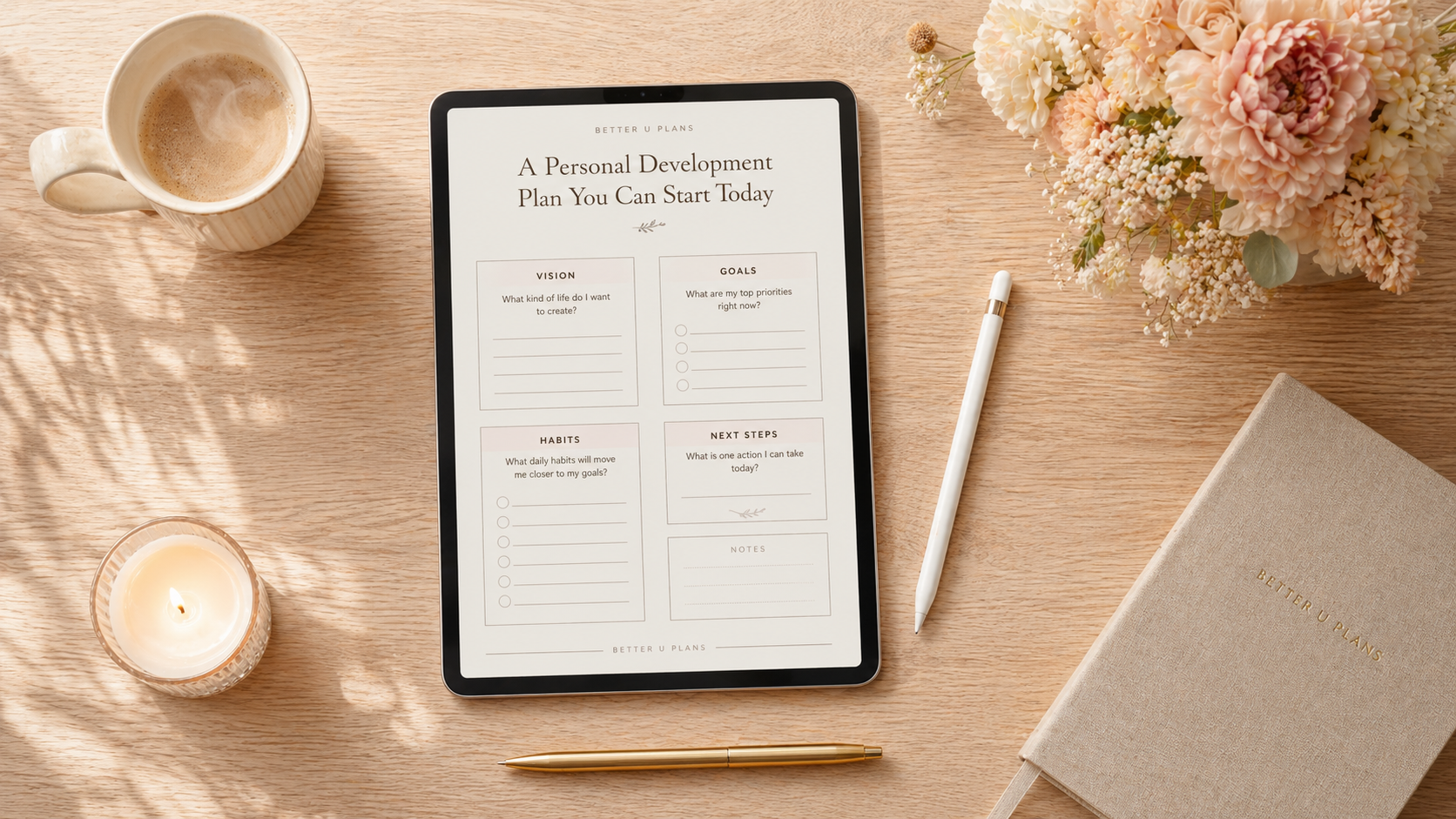
Here's how to build one, step by step.
What you'll learn
Why most personal development plans fail within two weeks and what to do differently
The 6 Better U Pillars framework for growing every area of your life, not just the most visible one
A 7-step plan you can build in under an hour and actually follow through on
You've started plans before.
Maybe a lot of them. The notebook that felt full of possibility in January and sat untouched by March.
The habit tracker you designed with color-coded pens and abandoned after eleven days. The vision board that made you feel hopeful for about a week before real life moved back in and took over the couch.
That doesn't mean you're bad at growth. It means you were handed the wrong kind of plan.
Most personal development plans are built for a version of you that doesn't exist, someone with unlimited time, consistent motivation, and zero competing demands.
That woman isn't real. And any plan that requires her to show up is a plan designed to fail.
The plan you're about to build is different.
It was designed for the real you, the one reading this between errands or after bedtime stories, the one who genuinely wants more for her life but has a lot already on her plate.
It's strategic without being rigid. Faith-rooted without being preachy. And most importantly, it's livable.
Let's build it together.
- 01 Why most PDPs fail (and what to do instead)
- 02 The 6 Better U Pillars: Your whole-life framework
- 03 Define your north star before you plan
- 04 Choose your pillars + set SMART-ER outcomes
- 05 Build your monthly rhythm + friction-free habits
- 06 Track what matters, reflect, and adjust
- 07 Common roadblocks + your 7-day kickoff checklist
Why Most Personal Development Plans Fail
Here's the hard truth: most plans fail not because the person wasn't motivated enough, but because the plan itself was designed around a motivation spike, not a sustainable system.
We get inspired, we write down fifteen goals, we buy the planner, and then we change exactly zero daily behaviors. Two weeks later, we're wondering why nothing moved.
There are four things that separate a plan that sticks from one that collects dust:
Focus. Fewer, better goals mapped to what actually matters in this season of your life, not every season at once. Trying to fix everything at once is how you fix nothing.
Friction reduction. The next step needs to be obvious and easy. If your plan requires you to remember seven things before you even start, it won't survive contact with a busy Tuesday.
Feedback loops. Growth without reflection is just motion. You need built-in moments to check in, adjust, and recommit — not just at the end of the year, but monthly.
Identity alignment. The most powerful shift you can make is this: stop acting from where you are, and start acting from who you're becoming.
A woman who journals doesn't wonder if she should journal today. It's just who she is.
Keep these four in mind as we build. They're the filter every decision in your plan should pass through.
The 6 Better U Pillars:
Your whole-life framework
Most goal-setting focuses on one or two areas of life, usually the ones that feel the most urgent or the most visible.
But growth that only happens in one place isn't really growth. It's just rearranging your priorities, not expanding them.
The 6 Better U Pillars are the framework at the heart of everything Better U Plans is built on.
They cover every dimension of who you are, not just the productive parts, not just the spiritual parts, but all of it.
Because you are not just your career. You are not just your faith. You are not just a mother or a professional, or a woman trying to get healthy.
You're all of those things at once, and a real plan has to hold space for all of them.
Here's the framework:
Mindset, clarity, emotional regulation, thought patterns, and how you talk to yourself on a hard day.
Energy, sleep, movement, nourishment — the foundation everything else sits on.
Prayer, faith practice, values alignment, and the quiet anchor that keeps you grounded when life gets loud.
Connection, boundaries, routines, and showing up for the people who matter most.
Skills, income, impact, and the work that feels like it was made for you — not just assigned to you.
Home systems, finances, joy, rest, and the everyday details that either support or drain your life.
You don't have to overhaul all six at once.
In fact, please don't.
The goal isn't to attack every pillar simultaneously; it's to identify where one small shift would create the biggest ripple.
We'll get to that in Step 2.
But first, notice something: when you look at these six pillars together, you can probably already feel which ones are thriving and which ones have been quietly neglected.
That feeling is data. And it's the beginning of your plan.
"A plan that only grows one part of you will eventually feel hollow, no matter how much progress you make in that one area."
Step 1:
Define your north star (vision + values)
Before you write down a single goal, you need to know what you're actually moving toward.
Not in a vague "I want to be happier" way. In a specific, this-is-what-my-life-looks-and-feels-like way.
Your north star is a simple vision statement (two to three sentences) that describes what a remarkably good season would look like for you.
Not perfect. Remarkably good.
There's a difference.
To write yours, answer these questions honestly:
What would feel different in your daily life if the next twelve months went really well?
Which values: faith, family, health, creativity, peace, generosity do you want your calendar to actually reflect, not just talk about?
If you stripped away everyone else's expectations, what would you be moving toward?
Here's an example of what a north star statement looks like in practice:
"I build a calm, focused life rooted in faith and family. Each day, I invest in my energy, protect my time, and move one small step closer to the work I was made for."
Simple. Specific enough to be meaningful. Broad enough to hold a whole season. Read it at the start of each week.
Let it be the filter your decisions pass through.
Journal prompt to try tonight: If the next 12 months went remarkably well, what would feel different in my daily life? Which values do I want my calendar to actually reflect, not just mention? Write for ten minutes without filtering. Your north star is already in there.
Step 2:
Choose 1–2 pillars to focus on this season
Ambition says fix it all. Strategy says start where the leverage is.
Look back at the six pillars. Ask yourself two questions:
Which pillar, if improved even slightly, would create the biggest positive ripple across the others?
And where am I feeling the most friction right now, the most stuck, the most drained, the most like something needs to change?
Those two questions will usually point you to the same one or two areas.
That's where you start.
Here's what that looks like in real life:
If your mind feels constantly cluttered and you can't seem to focus, that's a Mentality signal.
If you're running on five hours of sleep and caffeine by noon, that's Physicality calling.
If you feel spiritually disconnected, like you're going through the motions but not feeling grounded, that's Spirituality asking for attention.
If your most important relationships feel like they're getting your leftovers, that's Family.
Pick one or two. Write them down.
Then, and this is important, lovingly set the others aside for now. They're not forgotten. They're next.
Right now, your only job is to start where you're standing.
Step 3:
Set SMART-ER outcomes for each pillar
A goal without a clear measure is just a wish with better handwriting. That's where SMART-ER outcomes come in.
SMART-ER stands for Specific, Measurable, Achievable, Relevant, Time-bound, and then Evaluated and Refined over time.
That last part is what most goal-setting frameworks leave out, and it's the part that makes the difference between a goal that guides you and a goal that haunts you.
Here's what SMART-ER outcomes look like across different pillars, so you can see how this works in practice:
For Mentality:
"I will complete 30 guided journal sessions over the next 12 weeks, roughly 10 per month, to reduce mental clutter and create a clearer focus for each week."
That's specific, countable, realistic, and time-bounded. You know exactly what done looks like.
For Physicality:
"I will average 7 or more hours of sleep per night and log my bedtime at least five nights a week for 12 weeks."
Again: specific, trackable, and achievable without overhauling your entire life on day one.
For Career and Calling:
"I will turn one idea into a tangible mini-asset every two weeks, and make four meaningful connections each week to explore new income pathways."
This one has both a creation component and a relationship component, which builds momentum on two fronts.
Notice what these outcomes don't say.
They don't say "I will be more productive."
They don't say "I'll try to get more sleep."
They say exactly what success looks like, so there's no guesswork, just honest check-ins.
Step 4:
Build your monthly overview + reflection rhythm
This is the step most women skip, and it's the one that determines whether your plan actually lasts past the first month.
A monthly overview is not a to-do list. It's a strategic map of your month set at the beginning, so your days don't have to guess.
It answers the question:
What matters this month, in each area of my life, and how will I know if I showed up for it?
Here's what a monthly overview includes:
One intention per pillar (just one sentence, keep it tight)
A priorities list of your top six to eight non-negotiables for the month, important dates you need to plan around
And a Stop / Start / Keep decision: Stop one thing that's draining you.
Start with one small thing that moves the needle.
Keep one thing that's already working.
That's it, one of each.
Then, at the end of each month, you do the reflection. Not to judge yourself, to learn from yourself.
What were your wins? What did the data show (sleep, deep work, journal sessions, workouts)? Where did real life collide with your plan?
And who are you becoming through this process, not just what are you doing?
That last question is the one that separates a plan from a practice.
Growth that sticks isn't just behavioral. It's identity-level.
"I'm becoming a woman who protects her sleep" lands differently than "I'm trying to go to bed earlier."
One is a decision. The other is a negotiation you'll lose every night.
Step 5:
Design friction-free habits
A habit that requires a lot of willpower is a habit that won't survive a hard week. And you will have hard weeks.
So the goal isn't to build habits that work when you're motivated, it's to build habits that work when you're tired, behind, and running on half a cup of coffee.
Four strategies that actually help:
Stack it. Attach the new habit to something you already do. "After I brew my coffee, I open my planner and write my Big 3 for the day."
The existing habit carries the new one. You don't have to remember it, just happens in sequence.
Shrink it. Make the first step embarrassingly small. Not "journal for 20 minutes." Just "open the journal." Not "work out for an hour." Just "put on your shoes."
The starting is the hard part. Once you're in, you'll usually keep going, but even if you don't, you still showed up.
Stage it. Set your environment up to make the right choice the easiest choice. Planner on the counter, not in a drawer. Water bottle filled and visible. Journal on your nightstand, not buried under mail.
You should be able to start without making a single decision.
Savor it. End every session with something that feels like a win, a checkmark, a quick gratitude line, a moment of acknowledgment.
Your brain needs to register that the habit felt good, not just necessary. That's what makes it want to do it again tomorrow.
The rule that changed everything: Never miss twice. One missed day is a pause. Two missed days is the beginning of a pattern. If you fall off (and you will sometimes), your only job is to come back the next day. Not to catch up. Not to start over. Just to come back.
Step 6:
Track what actually matters
Tracking sounds like a lot until you realize how much clarity it brings. You don't need to track everything, just the three to five inputs and outputs that tell the most honest story about how your month went.
Inputs are what you put in: sleep hours, journal sessions, prayer time, movement, deep-work blocks, reading sessions.
These are the things you control directly.
Outputs are what comes from those inputs: your energy level, the projects you shipped, the relationships that deepened, the faith that grew quieter and stronger.
Track both, because inputs without outputs feel like effort without return, and outputs without inputs feel like luck without a system.
Pick your three to five. Write them in your planner. Check them weekly. And at the end of each month, let the numbers tell you the truth before your feelings get a chance to distort it.
Sometimes you'll see more progress than you felt. Sometimes you'll see exactly where things fell apart.
Both of those are useful. Neither of them is failure.
Step 7:
Your Monthly Retrospective: The Honest Check-In Every Growing Woman Needs
Think of this as a fifteen-minute executive meeting with yourself, for yourself. No agenda other than honesty and forward motion.
Ask four questions:
What moved the needle this month?
Where did friction show up, and what does that friction tell me?
Which goals are no longer aligned with this season, even if they were good goals when I set them?
And based on all of that, what am I recommitting to next month?
That last question is important.
Recommitment isn't the same as starting over. It means you looked at the data, adjusted what needed adjusting, and chose to keep going.
That's not weakness. That's wisdom. And it's exactly what the women who actually follow through do differently from the ones who don't.
Aim for 80% clarity, 100% commitment.
Your plan doesn't need to be perfect. It needs to be yours, and it needs to keep moving.
The roadblocks that will come and how to move through them
Every woman who has ever tried to grow intentionally has hit at least one of these.
Here's how to move through them without scrapping the whole plan:
"I don't have time."
This is almost always a prioritization problem, not a time problem. The question isn't whether you have time; it's whether this is on your priorities list. If it's not written down as a priority, it will always lose to whatever feels most urgent. Schedule it first. Give it the slot you'd give a meeting you can't miss.
"I lose momentum after a week."
Motivation follows momentum, not the other way around. The feeling comes after you start, not before. Shrink the habit until it's almost impossible to skip, and use the Never Miss Twice rule. One off day is rest. Two off days is a pattern. Come back before it becomes a pattern.
"I keep rewriting instead of doing."
Perfectionism is just procrastination in a prettier outfit. Your plan doesn't need to be complete before you start; it needs to be good enough to begin. Aim for 80% clarity, then move. The Monthly Retrospective is where you refine. The other 29 days are for doing.
"I try to do it all alone."
Growth gets lonely when it's invisible. Share at least one outcome with someone who will ask about it. Or use your planner's Growth Check-In pages to coach yourself on paper, write down where you are, what you need, and what your next step is. Sometimes you just need to say it out loud, even if it's only to the page.
Your 7-day kickoff starts today, not Monday
Day 1 Write your vision + values. Ten to twenty minutes. Don't overthink it. Your gut knows.
Day 2 Choose your 1–2 pillars for this season. Look at the six and ask: where is the most friction right now?
Day 3 Write 1–2 SMART-ER outcomes per pillar. Specific, measurable, and realistic for real life.
Day 4 Build your Monthly Overview: intentions per pillar, top priorities, important dates, Stop/Start/Keep.
Day 5 Set up your Monthly Reflection prompts and schedule your end-of-month review on your calendar now.
Day 6 Design your friction-free habits. Stack, shrink, stage, and savor. Pick three and make them obvious.
Day 7 Mini check-in and gratitude. Notice what you built this week. Then rest. You've earned it.
You don't need a special date to start becoming who you were made to be.
You just need a clear north star, a system you'll actually use, and the courage to take the next step even when it's small, even when it's messy, even when you're not sure it's working yet.
It's working. Keep going.
If you found this post helpful or know a friend who could benefit from it, make sure to share it! And don’t forget to pin it for later!
Ready to stop planning to plan and actually begin?
The Becoming System brings together the God, Goals, Grind Planner, and the Chapters of Growth Reading Journal, everything you need to build a life that actually reflects who you are and where you're going. No more scattered goals or forgotten insights. Just clarity, structure, and growth that fits your real life.
Get the Becoming System →
Other Posts You’ll Like 💛

Clear is kind. Unclear is unkind.
— Brené Brown
