

The Power of a 90-Day Plan: How to Achieve More in Less Time
A step-by-step guide for women who are done starting over and ready to start finishing.
Goal Setting · 90-Day Plan · Productivity & Planning · ⏱ Approx. Read Time: 10–12 min
This post may contain affiliate links. If you choose to grab something I recommend, I’ll earn a small commission (at no extra cost to you). Thank you for helping me keep creating resources that empower women like you!
You have started over more times than you can count.
January comes, and you feel it, that electric sense of possibility, the clarity of knowing exactly who you want to become.
You write it all down.
You make the plan.
You are ready.
And then six weeks later, the notebook is buried under a pile of mail. The goals feel like they belong to a version of you that had more energy, more time, more of everything.
So you quietly table it and tell yourself you will try again next quarter.
Except next quarter looks a lot like this one.
If this sounds familiar, here is what I want you to hear before we go any further:
You do not have a discipline problem.
You have a planning structure problem.
The gap between your vision and your follow-through is not about willpower; it is about time horizons.
A year is too long.
A month is too short.
And most women never discover the middle ground that actually works.
That middle ground is a 90-day plan.
And when it is built the right way, it does not just help you set goals, it helps you become someone who keeps them.
What You’ll Learn In This Post
✦ Why 90-day planning outperforms yearly goal-setting for most women
✦ What you can realistically accomplish in a single season
✦ How to choose the right goal instead of the most impressive one
✦ A step-by-step method to break big goals into monthly milestones and weekly actions
✦ How to track progress without perfectionism derailing you
✦ Why your faith, values, or spiritual anchor belongs in your planning practice
✦ How to adjust your plan without abandoning it entirely
- 01 Why a 90-Day Plan Works So Well
- 02 What You Can Actually Accomplish in 90 Days
- 03 Step 1: Choose One Clear, Meaningful Goal
- 04 Step 2: Break It Into Monthly Milestones
- 05 Step 3: Turn Milestones Into Weekly Action Steps
- 06 Step 4: Plan Your Days With Intention
- 07 Step 5: Track Progress and Celebrate Small Wins
- 08 Step 6: Adjust Without Giving Up
- 09 Your Next 90 Days Start Now
Why a 90-Day Plan Works So Well
There is a reason most goal-setting systems quietly fail by February, and it is not laziness.
It is neuroscience.
Your brain struggles to stay emotionally connected to outcomes that are twelve months away.
The reward feels too abstract, too distant.
So motivation fades, and without motivation, habits do not stick.
A 90-day window does something different.
It is close enough that you can feel the urgency (the deadline matters), but long enough that you have the runway to actually build something real.
Researchers call this the "planning horizon sweet spot," and the most effective goal-setters, athletes, executives, and entrepreneurs have been operating inside it for decades.
But beyond the science, there is a softer truth: twelve weeks gives you permission to be human.
You can hit a rough patch in week four and still recover by week eight. You can pivot in month two and still finish strong in month three.
A year feels too long to care about any given week. Ninety days keeps every week accountable… without crushing you under the weight of everything you have not done yet.
A 90-Day Plan Works Because It:
Creates urgency without panic. Your deadline is close enough to matter, which makes procrastination harder to justify.
Keeps you mentally engaged. Staying committed to something for 12 weeks is genuinely achievable in a way that 12 months rarely is.
Makes progress visible faster. You can see what is working, what is stalling, and what needs adjusting before you have lost the whole year.
Builds identity through consistent wins. Each small milestone you hit quietly reinforces the belief that you are someone who follows through.
And that identity shift is more powerful than any single goal.
Gives you permission to reset sooner. Instead of waiting until January, you get four fresh starts per year.
That changes everything.
A 90-day plan helps you stop thinking in all-or-nothing cycles and start thinking in intentional seasons.
What You Can Actually Accomplish in 90 Days
A lot more than you think and probably less than you are currently trying to do at once.
This is where most ambitious women get tripped up. They do not lack goals; they have too many of them competing for the same attention.
In a single season, they want to launch a business, overhaul their eating habits, read ten books, rebuild their morning routine, and show up better as a mother, partner, and friend.
Each goal is worthy. But together, they create a kind of internal noise that makes it nearly impossible to move on any one of them.
The 90-day framework asks you to resist that urge… and focus.
Not because your other goals do not matter, but because focus is what turns intention into momentum.
Think about what happens when sunlight passes through a magnifying glass. Spread out, it just warms the surface. Concentrated, it can start a fire.
R E A L L I F E S C E N A R I O
Keisha had been saying she wanted to build a consistent morning routine for two years.
She had tried everything: apps, habit trackers, aesthetic Pinterest boards, but nothing stuck because she was always trying to overhaul five things at once.
When she committed to just one 90-day focus (a grounded morning practice), she built a routine that held.
And because she had energy and confidence from that win, her next 90 days were stronger, too.
In 90 days, you can:
— Build a consistent morning or evening routine that actually holds
— Declutter and organize your home room by room
— Strengthen your prayer life, meditation practice, or spiritual connection
— Improve your energy through better sleep, movement, or nutrition habits
— Make measurable progress on a business or creative goal
— Read and meaningfully apply several personal growth books
— Create better rhythms for your family, finances, or relationships
— Begin stepping into the version of yourself you keep putting off
Notice the word "begin" in that last one.
Ninety days is not about arriving. It is about getting into motion with enough intention that your momentum carries you forward into the next season, and the one after that.
STEP 1
Choose One Clear, Meaningful Goal
This step sounds simple.
It is not.
Choosing one goal requires something most productivity advice skips entirely: letting go of the others, at least for now.
That quiet grief of setting something aside is real, and it is worth naming. You are not abandoning your other dreams.
You are giving this one its best chance.
The most common mistake here is choosing goals that are too vague to act on.
"Get my life together,"
"Be more productive,"
or
"Finally feel like myself again."
Are feelings, not targets.
Your brain cannot schedule a feeling. It needs something specific enough to know what action to take tomorrow morning.
A well-formed 90-day goal is specific, measurable, time-bound, and emotionally connected to something that actually matters to you in this season, not the season you think you should want.
Instead of vague, try specific:
Instead of: "Get in shape"
→ Try: "Work out four days per week and complete a 5K by week twelve."
Instead of: "Be more organized"
→ Try: "Implement a weekly planning system and maintain it every Sunday for 90 days."
Instead of: "Build my business"
→ Try: "Publish two blog posts per week and grow my email list by 200 subscribers."
After you have a specific goal, ask yourself two more questions:
Why does this matter to me right now, in this particular season of my life?
And:
What would progress actually look like at the 30-day mark?
If you cannot answer both, the goal needs more clarity before you start building around it.
Before you finalize your goal, take a moment to bring it to something bigger than yourself.
Whether you call it prayer, journaling, meditation, or simply sitting quietly with the Divine, this is the moment to ask:
Is this goal aligned with who I am being called to become right now?
Some of our most motivated seasons begin with a quiet confirmation rather than a burst of inspiration.
Trust that.
STEP 2
Break Your Goal Into Monthly Milestones
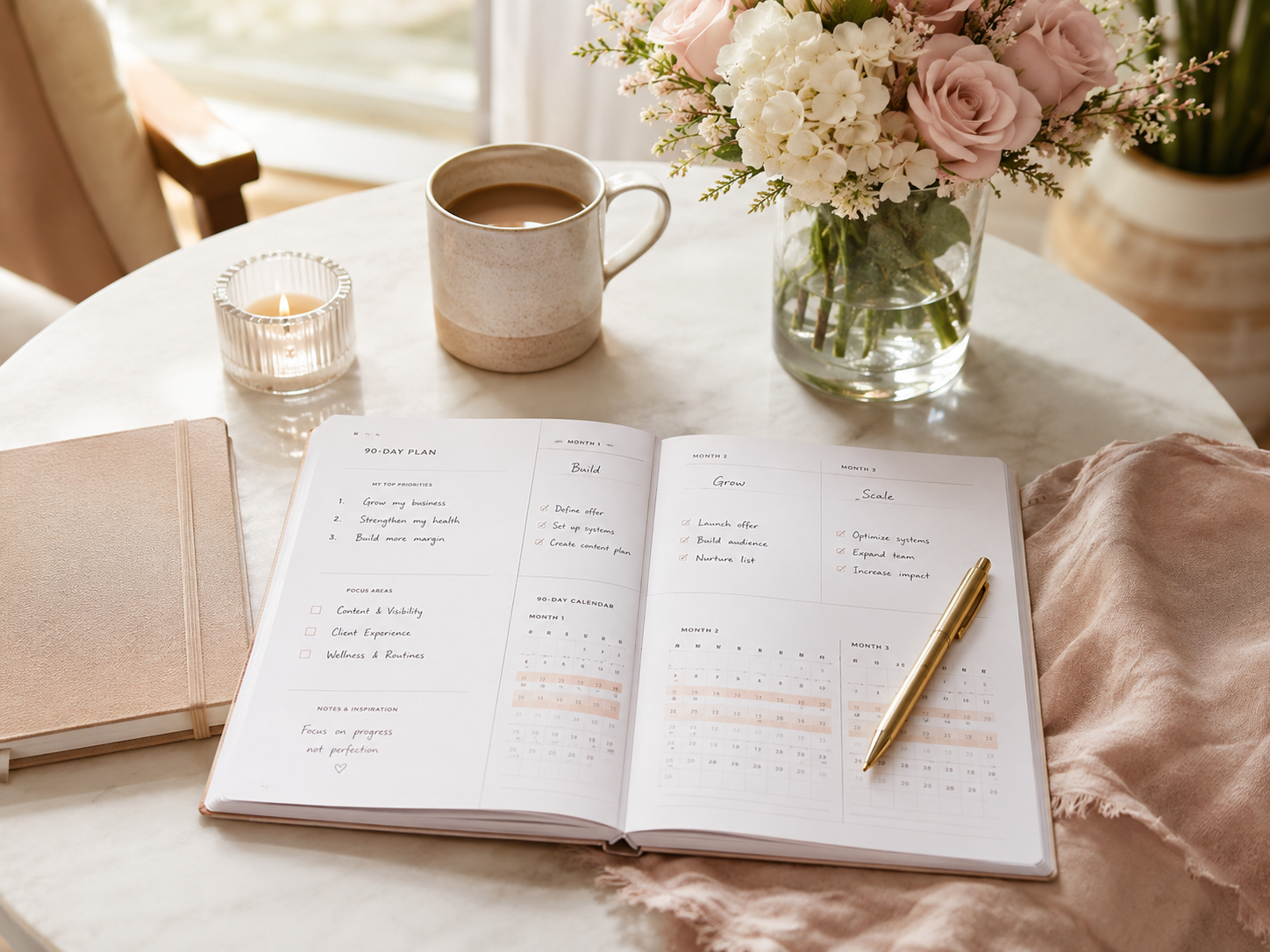
Now that you have your goal, you need a scaffold, a way to organize the 90 days so they feel like a progression rather than a countdown.
Monthly milestones do exactly that. They transform one big goal into three smaller chapters, each with its own job to do.
Think of it this way:
Month 1 — Build the foundation.
You are setting up systems, forming initial habits, and collecting your first small wins.
Expect friction here. New routines feel awkward before they feel natural. That is normal, not failure.
Month 2 — Strengthen consistency.
This is the hardest month for most women. The novelty has worn off, and real life has started pushing back.
This is where discipline becomes identity, the month where you decide who you actually are.
Month 3 — Evaluate and finish strong.
You track results, reflect on what shifted, and intentionally close the loop.
This reflection is not optional; it is what makes your next 90-day plan smarter and faster.
R E A L L I F E S C E N A R I O
Maya's 90-day goal was to read six personal growth books and actually apply what she learned, not just finish them.
Her Month 1 milestone: read two books, write one key takeaway from each, and choose one practice to implement.
Month 2: read two more, track what was changing in her thinking and behavior.
Month 3: complete the last two books, then write a reflection on who she was at day one versus day ninety.
By the end, she had not just read six books, she had built a reading practice and a reflection ritual that carried into her next season.
Your milestones do not have to be perfectly equal in size or complexity. What matters is that each one moves the needle in a direction that can be felt.
When you hit your Month 1 milestone (even if it felt small), your brain registers it as proof.
And proof compounds.
STEP 3
Turn Milestones Into Weekly Action Steps
A milestone tells you where you are headed. A weekly action step tells you what you are doing today, tomorrow, and Thursday.
This is the layer where most planning falls apart because most people stop at the milestone and expect willpower to fill in the gaps.
Weekly action steps are the bridge between intention and execution.
They answer the most important question in any goal-setting system:
What, specifically, am I doing this week?
Not this month. Not this quarter.
This week.
To find yours, ask:
What habits need to be in place for this milestone to happen?
What is the smallest version of this action that I can realistically commit to in this particular week?
What would get in the way, and what is my plan when it does?
R E A L L I F E S C E N A R I O
Dani's 90-day goal was to launch her online shop by week twelve.
Her weekly actions for Month 1 looked like this:
Monday — market research for 45 minutes.
Wednesday — write one product description.
Friday — choose and customize her shop template.
None of these felt impressive in isolation. But by the end of week four, she had a product, a platform, and a launch plan.
The magic was not motivation.
It was scheduling.
One thing worth noting: your weekly steps should feel slightly uncomfortable but not overwhelming.
If every week looks like a sprint, you will burn out by week five. If every week is too easy, you are playing small.
The goal is to operate just outside your comfort zone consistently, not heroically.
STEP 4
Plan Your Days With Intention
Here is the honest truth about goal-setting that mostly gets skipped: if it is not on your calendar, it is not a plan. It is a wish.
A 90-day plan without daily structure is like a road trip without knowing how much gas you have.
The destination is clear, but you are guessing whether you will make it.
Planning your days with intention does not mean scheduling every hour into submission.
It means creating a simple, repeatable rhythm that keeps your goal visible and your priorities protected.
For most women, that looks like three things: a weekly planning session, a daily top priority, and a brief end-of-day check-in.
The weekly planning session (even fifteen minutes on Sunday evening or Monday morning) is the single most impactful habit in this entire framework.
This is when you look at your monthly milestone, decide what needs to happen this week, and put it in your calendar before the week runs away from you.
Without it, your goals live in your head as background guilt.
With it, they live on your schedule as actual appointments.
R E A L L I F E S C E N A R I O
Jasmine is a mom of two who kept saying she did not have time for her goals.
The real issue was not time, it was that her goals had no protected space.
When she started treating her Sunday planning session like a standing appointment with herself (non-negotiable, thirty minutes, coffee in hand), everything shifted.
She was not doing more.
She was just deciding in advance, which meant she stopped spending mental energy all week, wondering when she would get to things.
This is also where a dedicated planning tool becomes less of a luxury and more of a necessity.
When your goals, milestones, weekly steps, and daily priorities all live in one place, your planning practice gains traction.
You stop starting from scratch every week and start building on what you already know.
The God. Goals. Grind. Planner was designed specifically for this kind of intentional, layered planning.
It gives you space to hold your 90-day vision, map your weekly priorities, and stay grounded in both purpose and progress all in one place, without the chaos of systems stitched together from five different apps.
STEP 5
Track Progress and Celebrate Small Wins
Tracking is not about perfection. It is not about proving anything to anyone.
Tracking is about awareness, and awareness is what separates women who keep going from women who quietly give up without realizing they were actually close.
When you are not tracking, you are flying blind. You do not know if Week 3 was harder than Week 2, or whether a specific habit is actually contributing to your goal.
You start every week from zero, with nothing to build on. Tracking gives you data, and data gives you power.
But here is the part most productivity resources miss: tracking also needs to capture the emotional landscape of your progress, not just the numbers.
Yes, note how many times you showed up.
But also note how you felt when you did.
✦ What was hard.
✦ What surprised you.
✦ What you are starting to believe about yourself that you did not believe thirty days ago.
Simple ways to track your 90-day progress:
A brief Sunday evening review — what worked, what did not, what needs to shift
A habit tracker that shows streaks and patterns at a glance
Monthly journal reflections on who you are becoming, not just what you are doing
A simple wins list: one line, one win, as often as possible
So many women move the goal post the moment they do something well. They hit a milestone and immediately pivot to what's left undone. But if you never pause to recognize your progress, the journey will start to feel like punishment.
Celebrating wins is not soft. It is strategic.
Your brain is wiring identity every time you acknowledge that you showed up.
Each celebration (even a quiet one) is reinforcing the neural pathway that says:
I am someone who does what she says she will do.
Over 90 days, those moments stack into a new self-concept. And that self-concept will outlast any single goal.
Your spiritual practice belongs here, too.
Whether you close out the week with prayer, gratitude journaling, meditation, or a moment of quiet reflection, this is where you reconnect with the why behind your goal.
It is easy to get so caught up in the grind that you forget what you were building toward in the first place.
Let your Higher Power, the Universe, or the Divine be part of your weekly reset.
You do not have to figure out every step alone.
STEP 6
Adjust Without Giving Up
Let us be honest about something: your 90-day plan will get disrupted.
A child will get sick.
A deadline will move.
A week will arrive that looks nothing like the one you planned, and you will feel the old familiar pull toward all-or-nothing thinking… the voice that says,
I missed four days, so I might as well start over next month.
Here is what I want you to understand: that voice is not wisdom.
It is conditioning.
And one of the most valuable things a 90-day framework teaches you is how to tell the difference between a plan that needs to be adjusted and a plan that needs to be abandoned.
Almost always, it is the former.
A strong plan is not rigid. It is responsive.
The women who reach the end of 90 days with real results are not the ones who had a perfect run, they are the ones who course-corrected early and often, without making every disruption mean something bigger than it was.
When you fall off track, ask:
Is my goal still the right focus for this season, or did something shift?
Are my weekly actions still realistic given what life actually looks like right now?
Have I been expecting perfection when all the plan requires is progress?
What is one small adjustment that would make it easier to keep going?
R E A L L I F E S C E N A R I O
Keisha hit week six and everything fell apart. A family emergency ate two full weeks.
When she came back to her planner, her first instinct was to scrap the whole quarter.
Instead, she sat down on a Sunday evening and asked one question:
What can I still finish in the time I have left?
She scaled back her milestone from launching a full product suite to launching one product well.
She finished.
And finishing (at any scale) changed what she believed was possible for her next 90 days.
Resetting is not the same as quitting.
Adjusting is not the same as failing.
The 90-day plan is a living document, not a verdict. Treat it that way, and it will serve you through seasons of abundance and seasons of hard.
The Becoming System: GGG Planner + COG Journal
When you pair intentional goal-setting with deep reflection and learning, something shifts... you stop just doing and start truly becoming. The Becoming System bundles the GGG Goal-Setting Planner and the Chapters of Growth Reading Journal into one complete growth toolkit for women who are serious about their next season.
GET THE BECOMING SYSTEM →A Book That Can Help You Stay Focused
If you want extra support as you build better systems, Getting Things Done by David Allen is a strong resource for learning how to manage tasks, reduce mental clutter, and create a workflow that feels more intentional.
It is especially helpful if you often feel like your goals get buried under everyday responsibilities.
Take what works, apply it to your season, and let it support your 90-day focus rather than overwhelm it.
✦ ✦ ✦
Your Next 90 Days Start Now
You do not need January.
You do not need a perfect Monday.
You do not need to have it all figured out before you begin.
Every season (even the ones that feel like aftermath) is a valid place to start.
What you need is a focused goal, a structure that can hold it, and the willingness to show up even when the plan gets messy.
That is it. That is the whole thing.
A 90-day plan will not do the work for you. But it will make the work feel possible.
It will give you something to return to when life pulls you sideways. It will help you build the kind of evidence (small win after small win) that eventually becomes an unshakeable belief in your own ability to follow through.
And when you build that with intention grounded in your values, connected to something bigger than your to-do list, supported by the right tools… it stops being just a plan.
It becomes a practice.
A season of becoming.
The next 90 days are going to pass regardless. The question is simply what you do with them.
Ready to Make Your Next 90 Days Count?
The God. Goals. Grind. Planner and the Chapters of Growth Reading Journal were built for exactly this kind of intentional, purposeful season.
Grab them together as The Becoming System and step into your next 90 days with a plan that was actually made for you.
If you found this post helpful or know a friend who could benefit from it, make sure to share it! And don’t forget to pin it for later!
Other Posts You’ll Like 💛
You Don’t Need More Discipline, You Need a Better Personal Operating System!
How to Rewire Your Brain for a Growth Mindset (The Science Behind Why You Stay Stuck)
Battling Screen Fatigue? How to Unplug, Reset, and Reclaim Your Life on Purpose
30-Day Self-Growth Challenge: Build Confidence, Find Your Focus & Finally Feel Like Yourself Again

“Dreams are lovely. But they are just dreams. Fleeting, ephemeral, pretty. But dreams do not come true just because you dream them. It’s hard work that makes things happen.”
- Shonda Rhimes
