

Planning with Purpose: How to Align Your Schedule with Your Core Values
Growth · Planning · Purpose · ⏱️ 9 min read
This post may contain affiliate links. If you choose to grab something I recommend, I’ll earn a small commission (at no extra cost to you). Thank you for helping me keep creating resources that empower women like you!
Have you ever looked at your to-do list and felt a quiet, sinking feeling, not because you had too much to do, but because none of it felt like you?
Like somewhere between the school pick-ups, the work deadlines, the group chats, and the laundry that never ends, you lost the thread of what you were actually trying to build?
If that hits close to home, you're not alone.
Millions of women are living full, busy lives that somehow still feel... hollow. Not because they're lazy or ungrateful, but because their days have been designed by default, not by design.
The real question isn't how to get more done. It's whether what you're getting done is actually moving you toward the life that matters to you.
That's what planning with purpose is about.
Not squeezing productivity out of every hour. Not becoming a morning routine machine.
It's about looking at your one precious life and making sure the way you spend your days actually reflects who you are and who you're becoming.
What You'll Learn
Why your schedule might feel misaligned (even when you're working hard)
How to identify your core values so you can plan around what actually matters
A simple, honest audit method to see where your time is really going
How to redesign your days with intention (without burning everything down)
The role of faith, reflection, and grace in sustainable planning
Tools and rituals that make purposeful planning stick long-term
How to give yourself permission to evolve as your season of life changes
- 01 The Real Reason Your Schedule Feels Off
- 02 Step 1: Define Your Core Values
- 03 Step 2: Audit Your Current Schedule
- 04 Step 3: Design Your Days with Intention
- 05 Step 4: Anchor Your Planning in Something Bigger Than Yourself
- 06 Step 5: Make Reflection a Non-Negotiable Habit
- 07 Step 6: Give Yourself Grace and Flexibility
- 08 Owning Your Time: The Permission Slip You've Been Waiting For
The Foundation
The Real Reason Your Schedule Feels Off
Here's the thing no productivity guru will say out loud: being busy and being purposeful are not the same thing.
In fact, busyness is often the thing that keeps us from purpose. It fills the space so completely that we never stop long enough to ask whether the space is being filled with the right things.
Think about the last time someone asked how you were doing, and you answered, "Busy."
It's become the default response and we wear it like a badge of honor when, for a lot of us, it's actually a quiet distress signal.
Busy doing what?
Busy for whom?
Busy getting closer to what?
The disconnect happens gradually. You said yes to a committee you didn't care about because you didn't want to seem difficult.
You started checking email before you even got out of bed because it made you feel ahead. You stopped going to your weekly yoga class because "something came up" and then something came up again, and again, until the class just fell off the calendar entirely.
None of these were dramatic decisions. They were tiny erosions. And over time, they add up to a life that feels just slightly, persistently off.
"Living with purpose doesn't happen by accident, it requires planning with purpose. And planning with purpose starts with a single, honest question: Does how I spend my time actually reflect what I believe about my life?"
— Better U Plans
The good news?
You don't need to blow up your entire life. You don't need more hours. You need a framework: one that helps you figure out what belongs in your days and what's been quietly stealing from them.
That's exactly what the steps below are designed to help you do.
Step 1
Define Your Core Values
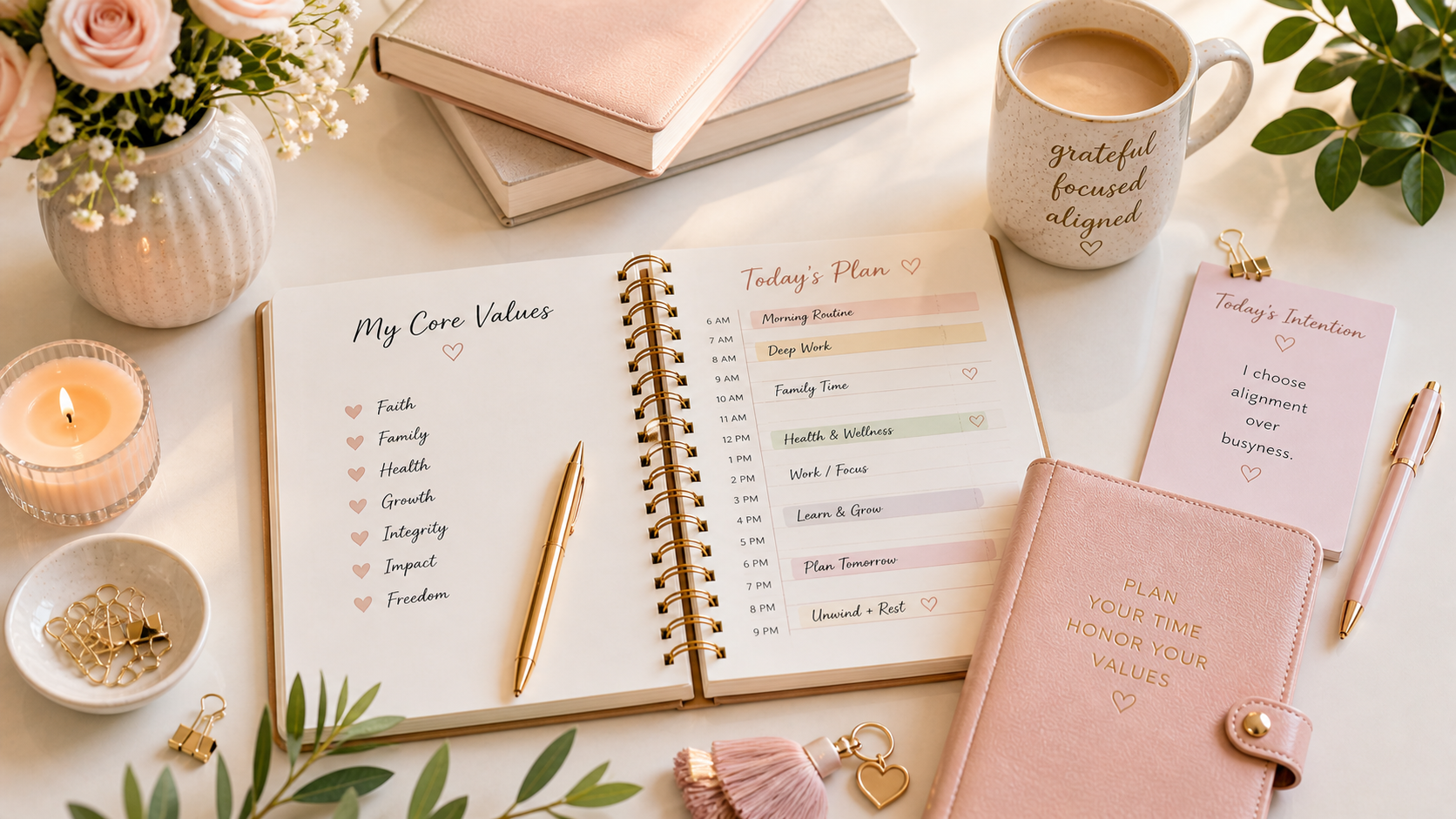
Before you can align your schedule, you need to get brutally honest about what's actually most important to you, not what sounds most virtuous, not what you think you're supposed to prioritize, but what you genuinely care about at a soul level.
Your values are your internal compass. When you're living in alignment with them, even hard days feel purposeful. When you're not, even easy days feel like a slow drain.
Here's where it gets real: a lot of women can rattle off their values in thirty seconds: "faith, family, health, growth." But when you look at how they're actually spending their Tuesdays?
Those values are nowhere to be found.
That's not a character flaw. That's the gap between intention and infrastructure.
And it's incredibly common.
So let's do this properly. Grab a notebook or better yet, open your Chapters of Growth Reading Journal, which is designed specifically for this kind of deep, intentional self-reflection, and sit with these questions honestly:
Values Discovery Prompts
What do I want my life to actually be about, not just in theory, but in daily reality?
When do I feel most like myself? What am I doing, who am I with, what am I building?
If I could only focus on three things for the rest of my life, what would they be, and am I spending time on any of them right now?
What would I regret never having made time for?
What drains me most, and is it because it conflicts with a value I've been ignoring?
Your answers will reveal your values whether that's faith, family, health, creative expression, financial freedom, community, or making an impact. And here's what most planning advice skips: values aren't permanent.
The woman you are at 28 isn't the same woman you'll be at 42. Your values evolve as your seasons change.
What matters right now is getting honest about what they are now, and building your schedule around that truth, not the truth from three years ago.
Pro Tip
Aim to identify 3–5 core values, not 15. When everything is a priority, nothing is. Narrowing your list forces the clarity that actually changes behavior.
Step 2
Audit Your Current Schedule
This is the step most people skip because it's uncomfortable.
Actually looking at how you spend your time, with the same honesty you'd apply to a bank statement, can be humbling.
But it's also the most transformative thing you can do. Because you cannot change what you won't acknowledge.
Here's a simple approach: for one week, track how you're actually spending your time in three-hour blocks. Don't adjust your behavior yet… just observe.
At the end of the week, map those activities against your values.
Ask yourself: Does how I'm spending my time match what I said I cared about?
Picture this:
A woman named Danielle, a marketing manager and mom of two in her late thirties, did this exercise and discovered that she was spending an average of two hours a day on social media (mostly scrolling, not creating), ninety minutes a day on email outside of work hours, and less than twenty minutes a day on anything she'd identify as spiritually grounding.
Health was one of her top three values. She hadn't worked out in six weeks. The audit didn't make her feel guilty, it made her feel clear.
And clarity is where change begins.
"The audit isn't about shame. It's about seeing. You can't reroute a journey without knowing where you currently are."
Common misalignments to look for:
Family is a core value, but evenings are filled with work emails and screen time.
Not because you don't love your family but because the structure of your evening never got intentionally designed.
Health is a priority, but workouts keep getting bumped.
Because they're scheduled last, which means they're the first thing to go when something "more urgent" comes up.
Faith or spirituality matters deeply, but prayer, meditation, or reflection has become an afterthought.
Because you never protected time for it the way you protect a work meeting.
The Honest Audit Question
For each block of time in your week, ask: "Is this getting me closer to the life I want, or is this just keeping me busy?" One question. Life-changing in its simplicity.
Step 3
Design Your Days with Intention
Now comes the part that actually changes things. Once you know what matters and where your time is currently going, you can start making different decisions deliberately, sustainably, without trying to overhaul your entire life in a weekend.
The key is to stop treating your most important things as optional. The workout isn't optional, it's on the calendar.
The journaling practice isn't something you'll do "when you have time", it has a time. The family dinner isn't something that just "happens", it's protected.
When you treat your values like appointments, they start showing up in your life like appointments.
That's not rigid. That's intentional.
Prioritize Non-Negotiables First
Before you schedule anything else for the week, block off time for the things that fuel your soul: prayer, movement, journaling, deep work, connection with the people who matter most.
These go in first, not last. Not "if there's time." First. This single shift can change the entire texture of your week.
Learn to Say No Without Over-Explaining
Every yes you say to something that doesn't align with your values is a no to something that does.
That's not dramatic, it's arithmetic (Logic).
If you're a chronic yes-person (and if you're reading this, there's a decent chance you are), start practicing the soft decline:
"That doesn't work for me right now, but thank you for thinking of me."
Full stop.
You don't owe anyone a five-paragraph essay justifying your boundaries.
Batch Your Tasks and Respect the Blocks
Context-switching is one of the biggest silent time thieves. When you respond to emails all day instead of batching them into two focused windows, you're constantly pulling your brain out of deep work to handle shallow tasks.
Create intentional time blocks, creative work in the morning, admin in the afternoon, family time in the evening, and protect them.
Design a Morning Routine That Sets the Tone
Your morning doesn't have to start at 5 AM (though if that works for you, Robin Sharma's The 5 AM Clubis worth exploring).
What matters is that it starts with you, before the world's agenda floods your mind.
Even twenty intentional minutes of stillness, movement, and grounding before you check your phone can shift the entire energy of your day.
Step 4
Anchor Your Planning in Something Bigger Than Yourself
Here is something that most productivity books will never tell you: the most sustainable planning doesn't come from willpower.
It comes from meaning.
And meaning (real, deep, unshakeable meaning) almost always has a spiritual dimension.
Better U Plans was built on the belief that intentional living isn't just a strategy. It's a calling.
Whether you call it God, the Universe, a Higher Power, or the Divine, there is something remarkable that happens when you align your daily life not just with your values, but with the sense that your life is part of a bigger story.
That your growth matters.
That the woman you're becoming isn't just for you.
Whether you bring your plans to God in morning prayer, set your intentions through meditation, journal your gratitude to the Universe, or simply begin your day by acknowledging something greater than yourself, that anchoring practice changes everything.
It moves planning from a task on your to-do list to an act of faithfulness to your own becoming.
Think about it this way: when a decision aligns with your values and your faith, the motivation to follow through is completely different.
It's not just "I want to be healthier."
It's "I want to honor the body I've been given."
It's not just "I want to build something meaningful."
It's "I believe I was put here for a reason, and this is part of that reason."
That's a different kind of fuel. That's the kind that doesn't run out.
So as you design your week, leave space for the spiritual. Not as an afterthought, but as an anchor. And if you're not sure what that looks like for you yet, that's okay too. The practice of looking for it is already the beginning.
Faith-Aligned Planning Prompts
What do I believe I'm being called toward in this season of my life?
How can I approach this week as an act of faithfulness to my purpose?
Where do I feel resistance — and could that resistance be pointing me toward something important?
Step 5
Make Reflection a Non-Negotiable Habit
Planning without reflection is just scheduling. It's moving boxes around on a calendar without ever asking whether those boxes are actually serving you.
Reflection is what turns planning into growth. It's the difference between going through the motions and genuinely evolving.
At the end of each week (Sunday evenings work beautifully for this) sit down with your planner and journal and ask three questions:
Did my schedule align with my core values?
What worked, and why?
What didn't, and what would I do differently?
This is where the Chapters of Growth Reading Journal becomes more than a reading companion. It becomes a living record of your evolution.
If you're working through a book like The 5 AM Club or any other personal development resource, this journal gives you a place to absorb the ideas, translate them into action, and track how they're actually showing up in your life, not just in theory, but in practice.
The women who experience the most transformation aren't the ones who consume the most content.
They're the ones who apply it.
Consistently.
Imperfectly.
Week after week.
Weekly Reflection Ritual
Pair your Sunday reflection with something you love, a good candle, your favorite tea, twenty minutes of quiet before the week begins.
When reflection becomes something you look forward to, it becomes something that actually happens.
Step 6
Give Yourself Grace and Flexibility
Let's talk about the thing nobody wants to admit: purposeful planning will fall apart.
Not might.
Will.
Life is not a controlled environment. Kids get sick. Work blows up. Grief shows up uninvited. The season you're in shifts, and the plan you made for who you were last month may not fit who you are today.
And here's the trap that a lot of high-achieving, growth-minded women fall into: when the plan breaks down, they conclude that the plan failed.
They feel like they failed. And they abandon the whole thing until they can "start fresh", usually on a Monday that never quite arrives.
Grace is not the enemy of discipline.
Grace is what makes discipline sustainable.
The goal is not a perfect week. The goal is a life, built over thousands of imperfect weeks, that keeps moving in the right direction.
Progress over perfection isn't a motivational platitude. It's the actual mechanism of change.
"The plan isn't sacred. The direction is. Give yourself the grace to miss a day, adjust a goal, or pivot entirely, and then get back to it. That's not failure. That's how growth actually works."
When things fall off track (and they will) the question isn't "why can't I stick to anything?"
The question is:
"What do I need to adjust so this is actually sustainable for my real life?"
That's a completely different question.
One leads to shame.
The other leads to solutions.
Also: your values will shift over time, and your planning system should shift with them.
The priorities of a 28-year-old navigating early career are different from the priorities of a 38-year-old raising children and building a business simultaneously.
Build enough flexibility into your system to honor the woman you're becoming, not just the woman you were when you set up the plan.
The Takeaway
Owning Your Time: The Permission Slip You've Been Waiting For
You don't need more hours. You need more intention. You don't need to overhaul everything at once. You need one honest look at where your time is going, one clear set of values to plan around, and one sustainable system to hold it all together.
You are allowed to design your life differently than you have been. You are allowed to say no to things that don't align. You are allowed to protect your mornings, your Sundays, your creative hours, your prayer time, with the same ferocity you'd protect any other appointment.
You are allowed to take your own becoming seriously.
That permission? You don't need anyone to give it to you. But consider this your reminder that it was always yours.
Start today. Not with a complete overhaul.
With one question:
Does how I'm spending my time actually reflect what I believe about my life?
Sit with that. Write it down.
Let the answer guide what comes next.
Introducing The Becoming System
The God. Goals. Grind. Goal-Setting Planner + the Chapters of Growth Reading Journal: together, they're more than two products. They're one complete identity system designed to help you plan with purpose, grow with intention, and become the woman you were always meant to be.
Shop the Becoming System →"Your time is your life. Spend it like you mean it."
Better U Plans · Insights for Better U
If you found this post helpful or know a friend who could benefit from it, make sure to share it! And don’t forget to pin it for later!
Other Posts You Might Like 💛
How to Rewire Your Brain for a Growth Mindset (The Science Behind Why You Stay Stuck)
Battling Screen Fatigue? How to Unplug, Reset, and Reclaim Your Life on Purpose
Busy but Balanced: 7 Daily Habits to Stress Less and Live More
How to Heal Past Wounds Through Faith and Spiritual Alignment (Even When It Feels Impossible)
30-Day Self-Growth Challenge: Build Confidence, Find Your Focus & Finally Feel Like Yourself Again

“Don’t get so busy making a living that you forget to make a life.”
- Dolly Parton
