

From Self-Doubt to Self-Trust: A Real-Talk Guide for Your Anxious Heart
Self-doubt · Self-trust · Confidence habits for women · ⏱ Approx. Read Time: 9 minutes

This post may contain affiliate links. If you choose to grab something I recommend, I’ll earn a small commission (at no extra cost to you). Thank you for helping me keep creating resources that empower women like you!
"I should've said more. I should've done better. Who do I think I am?"
That voice did not appear because you were weak.
At some point, questioning yourself may have felt safer than being criticized, rejected, or told you were too much again.
If that voice lives in your head too, hear this first: you are not broken, and you are not alone.
A staggering number of women, smart, capable, overqualified women, carry a running commentary of self-doubt they'd never say out loud to a friend.
Here's the truth I want you to hold onto: self-doubt is a pattern, not your personality.
Patterns can be rewired.
Beliefs can be updated.
Self-trust does not mean you never second-guess yourself; it means doubt no longer gets the final vote.
And with the right tools, mindset, faith, and planning, you can gently move from "who am I to do this?" to "I was trusted with this, and I'm going to show up."
This isn't another "just believe in yourself" pep talk.
Because if a motivational quote and a cute mug could fix self-doubt, most of us would have been healed by Tuesday.
This is the heartwork behind your habits; the deeper why underneath the daily to-do list.
If you've read the "how to" post about a confidence-boosting morning routine, consider this the inner work that makes it stick.
If you haven’t, no worries, I’ll have the link to that post waiting for you at the end.
What You'll Learn
Why self-doubt shows up the way it does, how to interrupt the loop that keeps it running, and what daily practices actually rebuild trust in yourself.
Not through hustle, but through small, repeatable proof.
- 01 Self-Doubt Is a Pattern, Not a Personality Trait
- 02 The Self-Doubt Loop (And How It Works Against You)
- 03 Four Daily Habits That Rebuild Self-Trust: Speak, Write, Plan, Reflect
- 04 How Mindset, Faith, and Planning Work Together
- 05 Next-Level Strategies for Building Self-Trust
- 06 Two Books to Read Alongside This Work
- 07 Your Next Gentle Steps
1. Self-Doubt Is a Pattern, Not a Personality Trait
Self-doubt feels permanent, like it's just who you are, especially if you've heard versions of the same message for years.
"You're too much."
"You're not ready."
"Don't get your hopes up."
Maybe it was a parent, a teacher, or a boss who made you feel small for taking up space.
When you hear something often enough, your mind may begin repeating it in your own voice.
That does not make it true.
It only makes it familiar.
Over time, those comments become internal scripts. You start predicting failure before you even try.
Research shows people with lower self-esteem consistently underestimate their own performance, even when they're doing well.
Add social comparison and the pressure to "do it all," and you've got a recipe for chronic self-doubt.
Picture this: you're in a meeting, and you have the answer. But you wait, and someone else says almost the exact thing you were thinking.
They get the nod, the credit.
That's not a confidence problem.
It's a trust problem. You didn't trust your voice was allowed to take up space in the room.
You did not stay quiet because you lacked the idea but instead because part of you was still waiting for permission to trust the idea you already had.
Or maybe it's the business idea sitting in your Notes app for two years, researched and dreamed about but never started, because "someone's probably already doing it better."
At this point, your Notes app has become part business incubator, part dream cemetery. So you close the app and wait for a sign that never comes because it never feels big enough.
Here's the reframe: self-doubt is learned.
You weren't born doubting yourself; you picked it up from experience, environments, and voices around you.
What's learned can be unlearned.
You're not "a doubter." You're a woman who's had to survive in environments that didn't always affirm her.
That's different.
"You alone are enough. You have nothing to prove to anybody."
— Maya Angelou
You do not have to prove your worth before you begin. You only need a safer way to practice believing yourself.
2. The Self-Doubt Loop (And How It Works Against You)
You can't interrupt a loop you can't see, so here's what usually happens.
As you read this, resist the urge to judge yourself for recognizing the pattern.
Seeing the loop is not proof that you are stuck. It is the first moment you have enough distance to interrupt it.
Trigger
You're asked to lead something, or consider starting a business, applying for a job, or posting online. Your heart rate ticks up before your brain finishes the thought.
Thoughts
"I'm not ready." "Other women are more qualified." "If I fail, everyone will see." They don't feel like choices; they feel like facts.
Feeling
Tight chest. Racing heart. Overthinking that loops for hours. Anxiety, embarrassment, and shame, showing up in your body before you can name them.
Your body may be reacting before your wiser mind has time to remind you that this moment is not the old one.
Action, or inaction
You shrink your idea. You procrastinate. You say "maybe later" and quietly back away, or send the email after deleting three paragraphs of confident language first.
Result
The opportunity passes. You "prove" to yourself you're not the type of woman who does big things. The pattern gets stronger, and it whispers, "See? I told you."
A woman I know spent four months building a product she never launched, not because it wasn't good, but because she kept "improving" it instead of releasing it.
As long as it wasn't done, it couldn't be judged.
Keeping it unfinished protected her from judgment, but it also kept her from receiving proof that she could survive being seen.
That's the loop in action; procrastination wearing the costume of perfectionism.
Patterns are just loops, and loops can be interrupted.
You don't have to bulldoze your feelings or fake confidence you don't feel yet.
And you especially do not have to defeat the entire loop in one brave moment. You only need a few reliable places to interrupt it.
That's where: speak, write, plan, and reflect come in.
3. Four Daily Habits That Rebuild Self-Trust: Speak, Write, Plan, Reflect
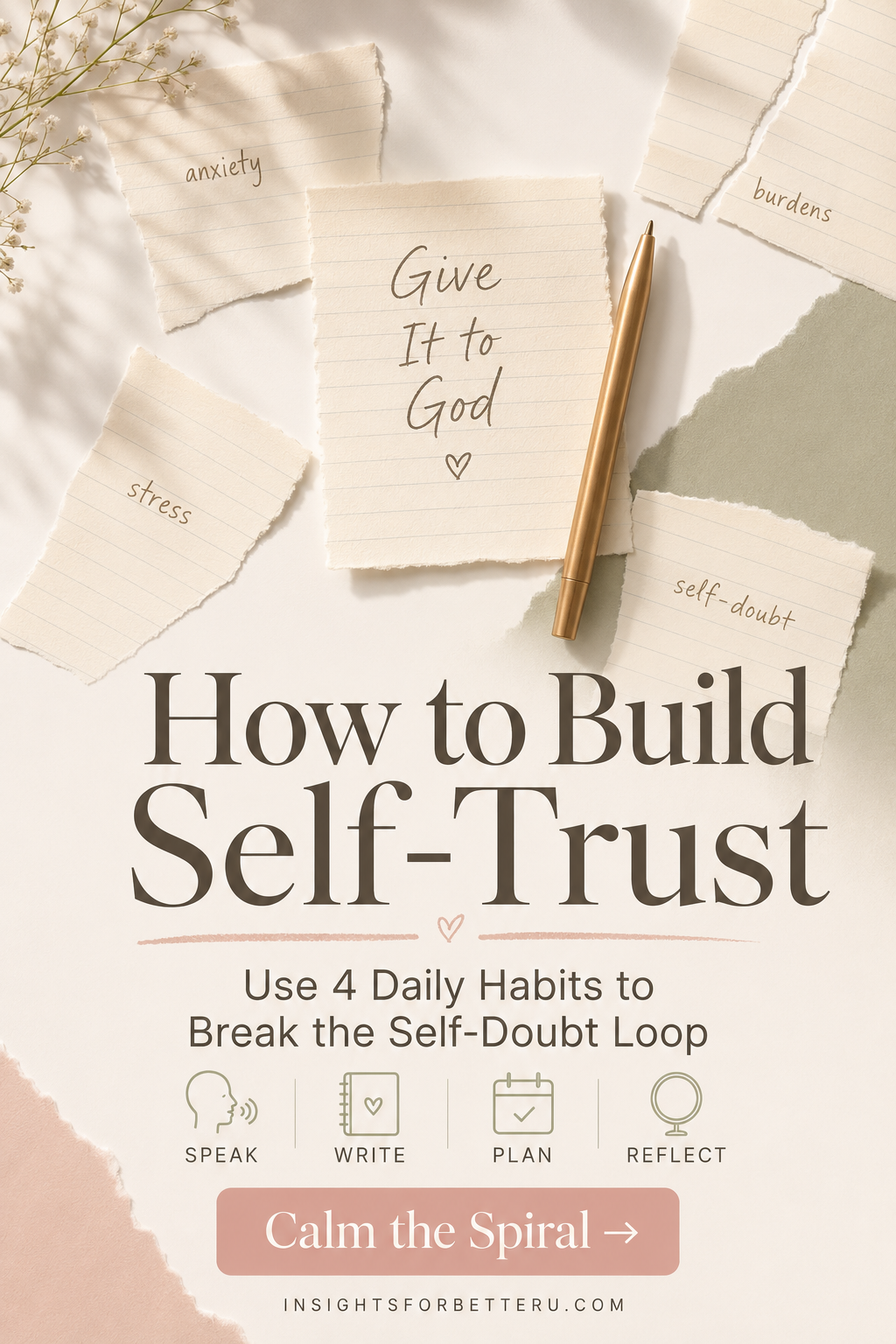
Save this for later: the 4 daily habits that rebuild self-trust.
These four habits are simple, but repeated consistently, they send your brain new evidence: "I can do what I say I'll do."
Speak: Train Your Inner Voice On Purpose
Your words are instructions to your nervous system.
Research on cognitive-behavioral techniques shows that reframing thoughts can reduce anxiety and improve confidence.
The goal is not to replace every fearful thought with something shiny and unbelievable.
Your nervous system knows when you are trying to sell it a slogan.
Try a daily "Thought Swap."
Notice the thought: "I always mess things up." Ask, is that 100% true, all the time?
It never is.
Replace it with something believable: "I'm still learning, but I've handled hard things before." Choose a sentence your mind can actually stand on.
Pro tip: build a Voice Memo Vault on your phone. Record yourself reading three to five affirmations as if you were coaching your best friend, then listen to it while driving or getting ready.
One woman told me the first time she heard her own voice say "you are allowed to take up space," she cried in a parking lot; not because it was sad, but because nobody had ever said it to her before.
Sometimes hearing kindness in your own voice feels unfamiliar before it feels natural.
Keep listening.
Write: Turn Vague Fear Into Clear Insight
Journaling isn't just "dear diary" anymore.
Studies show it can reduce anxiety and improve mood. When you write your fears down, they stop being a fog and become words you can see, question, and reframe.
Try this five-minute "Self-Doubt Deconstruction."
The story I'm telling myself:
"If I launch and don't profit, it proves I'm not good enough."
The facts: "I've gotten great feedback from early customers."
A kinder, truer story: "Launching is data, not a verdict. Even if it's slow, I'll learn and improve."
Once the fear is written down, it often becomes less like a prophecy and more like a sentence you are allowed to question.
You can do this on any blank page. The important thing is giving the fear somewhere to become specific.
This is also the kind of reflection the Chapters of Growth Reading Journal was designed to support; turning insights into emotional clarity instead of leaving them scattered across sticky notes.
Pro tip: keep an "Evidence of Growth" page weekly. Self-doubt keeps excellent records of your mistakes and strangely poor records of your courage; this page helps correct the filing system.
List three moments you showed up while afraid, three skills you're improving even if messy, and three ways God met you, strengthened you, redirected you, or helped you keep going.
You can also include the people, resources, and inner resilience that carried you through.
Plan: Build Self-Trust One Promise at a Time
Confidence isn't just thinking better thoughts; it's keeping small promises to yourself.
This is not about proving your worth through perfect follow-through. It is about becoming someone who responds to a missed promise with adjustment instead of abandonment.
When your calendar matches what you said you'd do, your brain learns, "I can trust myself."
In the God, Goals, Grind Goal-Setting Planner, you can set one to three non-negotiables a day instead of building a list so long that it begins criticizing you before breakfast. This gives you the space to assign tasks to real days so your dreams stop floating in "someday."
Try the Minimum Method:
movement minimum (a five-minute walk),
mindset minimum (one affirmation out loud),
grounding minimum (one prayer, verse, or quiet moment connecting to whatever "bigger than you" means to you)
progress minimum (one tiny action toward a goal).
Five minutes may grow into twenty, but it does not have to. The win is that you kept the promise small enough to return tomorrow.
And when you miss a day, and you will sometimes, self-trust is rebuilt by returning, not by punishing yourself for leaving.
Reflect: Turn Your Life Into Data, Not Drama
Most women only reflect when criticizing themselves. Reflection should help you understand yourself, not place you on trial.
Real reflection is looking at your days like a strategist. What worked? What drained me? Where did I ignore my gut?
Your Chapters of Growth Journal and the reflection pages in God, Goals, Grind give you guided space for this.
A guided page can help contain the reflection so it does not become a two-hour overthinking session with snacks.
Try the Friday "CEO of My Life" check-in.
Once a week, ask where you showed up bravely, what boundaries need tightening, and what tiny step you can take next.
Then add a few forward-looking questions too:
What felt easier this week because I trusted myself?
Where did I honor my own voice, and what deserves to be celebrated before I improve anything?
Reflect like a CEO instead of a critic, and your life stops feeling like a performance review.
4. How Mindset, Faith, and Planning Work Together
Think of your growth like a three-strand cord:
Mindset, how you think and speak to yourself.
Faith, who or what grounds you when your feelings become unreliable.
Planning, how you translate all of that into real, Tuesday-afternoon decisions.
For me, faith means remembering that I am not building confidence alone or inventing my worth from scratch.
God grounds what I believe about myself when my own feelings can't be trusted to tell me the truth.
You might experience that same kind of grounding through prayer, scripture, quiet reflection, or the values you hold onto no matter what season you're in.
However you get there, the point is the same: you stop trying to carry the whole thing alone.
The three work best together.
Mindset without faith feels like it's all on you.
Faith without planning turns into waiting instead of partnering with what you believe in.
Planning without mindset means you fill in the boxes but secretly still feel like a fraud.
Mindset may help you say, "I am allowed to try." Faith reminds you that your worth is secure either way. Planning puts the application on Tuesday's calendar.
Your planners aren't stationery; they're bridges.
Chapters of Growth helps you absorb the wisdom from what you're reading and turn insight into shift.
God, Goals, Grind anchors those shifts into routines so your life starts reflecting what you actually believe, not just what you post about.
"I now see how owning our story and loving ourselves through that process is the bravest thing that we will ever do."
— Brené Brown, The Gifts of Imperfection
These tools exist to help you own your story with intention, instead of editing it into something smaller.
5. Next-Level Strategies for Building Self-Trust
A few strategies to help you take this even deeper.
Create a Courage Portfolio
You already have evidence you can do hard things; you've just never filed it.
Do not wait for dramatic victories. Include the phone call you finally made, the boundary you held without over-explaining, and the day you showed up while your confidence was still in pajamas.
In Chapters of Growth, dedicate a spread to these moments and return here whenever you're about to shrink.
Borrow confidence from "Future You"
When doubt is loud, ask:
If the most confident version of me already existed, how would she handle this?
Future You is not a more worthy woman. She is simply the version of you with more practice.
Write her answer in your planner in a different-colored pen, label it "Future Me Says," and do one thing she'd do within twenty-four hours.
Design trigger habits for tough moments
We wait to feel confident before acting; that's backward.
Decide ahead of time what could help when doubt arrives: when you catch yourself doom-scrolling, close the app and answer one prompt in Chapters of Growth.
When you're tempted to cancel on a dream, open God, Goals, Grind and reread your "why this matters" page.
New habits often take longer to stick than the popular "21 days" myth suggests, closer to two months for many people, though the timeline really does vary from person to person and habit to habit.
Give yourself that room.
Set emotional goals, not just outcome goals
Alongside losing ten pounds or hitting a savings number, try: "respond to challenges with curiosity instead of shame," or "end each day with one thing I'm proud of."
Emotional goals give you a way to recognize growth even when the outcome is delayed.
6. Two Books to Read Alongside This Work
You do not need to read both books, finish them quickly, or turn personal growth into another syllabus.
Choose the one that speaks most directly to where self-doubt is showing up right now.
For the Action Side
Atomic Habits by James Clear
For the woman who keeps creating ambitious new beginnings but needs a gentler way to keep going after the excitement fades.
Clear's core idea, that every action is a vote for the person you want to become, is basically the science behind the "Plan" section above; tiny, consistent actions beat big overhauls.
For the Inner Work
The Confidence Code by Katty Kay & Claire Shipman
Why it fits this guide:
It unpacks how shame, perfectionism, and “never enough” thinking keep women playing small.
It gives you language and practices to live more courageously and authentically- key ingredients in self-trust.
Whichever book you choose, use the Chapters of Growth Reading Journal to capture what feels personal, what challenges an old belief, and what you want to practice beyond the page.
7. Your Next Gentle Steps
If your self-doubt runs deep, hear this: you don't need a personality transplant. You need a system that supports who you're becoming.
You do not need to feel convinced before you begin. "True-ish" is enough for the first affirmation.
Five minutes is enough for the first page. One small action is enough evidence for today.
Start here, gently.
Choose one affirmation that feels true-ish, not fake.
Write for five minutes about where it feels hardest.
Plan one tiny action that aligns with it.
Reflect at day's end on how it felt to follow through, even imperfectly.
Repeat.
Let it be messy. Let it be sacred, something you bring to God honestly, without pretending you are more confident than you feel.
Most importantly, let it be yours.
The hardest part is not always knowing what to do. It is having somewhere to return when doubt becomes loud again.
If you're ready to stop treating your confidence like a "someday" project, the Becoming System, pairing Chapters of Growth with God, Goals, Grind, was built exactly for this: a daily reminder that your story is not over, and your growth is not accidental.
Name one pattern you are ready to interrupt. Then choose the smallest action that would give your mind new evidence today.
When you want a structured place to keep practicing, the Becoming Systemis there to support the process.
When you're ready to turn this heartwork into a daily flow, read “How to Create a Confidence-Boosting Morning Routine (Even If You're Not a Morning Person)” for a gentle routine you can start tomorrow morning.
You're not behind.
As Michelle Obama wrote in Becoming, reflecting on a question she's asked herself through every hard climb:
"Am I good enough? Yes, I am."
— Michelle Obama, Becoming
You may not believe it with your whole chest yet. That is okay. Self-trust often begins as a whisper you choose to stop arguing with.
If you found this post helpful or know a friend who could benefit from it, make sure to share it! And don’t forget to pin it for later!

“You have been criticizing yourself for years, and it hasn’t worked. Try approving of yourself and see what happens.”
— Louise Hay
